
DJI Matrice 400 Enterprise Drone (No Batteries / No Care)
W-9 and vendor pack with every quote
Shipped direct from the manufacturer
59 minutes carrying only the H30T, an IP55 rating that five specific things void, and accessories that do not cross from a Matrice 350.
01
Five gimbal cameras fit this aircraft, and four are also on DJI's Matrice 350 RTK list
The gimbal, the motorized mount a camera sits on, starts this decision. DJI's FAQ names five gimbal cameras: the Zenmuse L3, H30, H30T, L2 and P1. Four of them, all but the L3, are on DJI's Matrice 350 RTK list. DJI lists gimbal cameras separately from accessories, and states that accessories for the Matrice 400 and the Matrice 350 are not compatible with each other, though DJI's own lists put the D-RTK 2 Mobile Station on both aircraft. DJI confirms there is no upward gimbal connector on this aircraft. Our SKU is the No Batteries / No Care configuration, without the flight battery or DJI Care Enterprise. Call us and we will confirm the packing list before you order.
The flagship platform, introduced
DJI Enterprise's launch film for the Matrice 400.
02
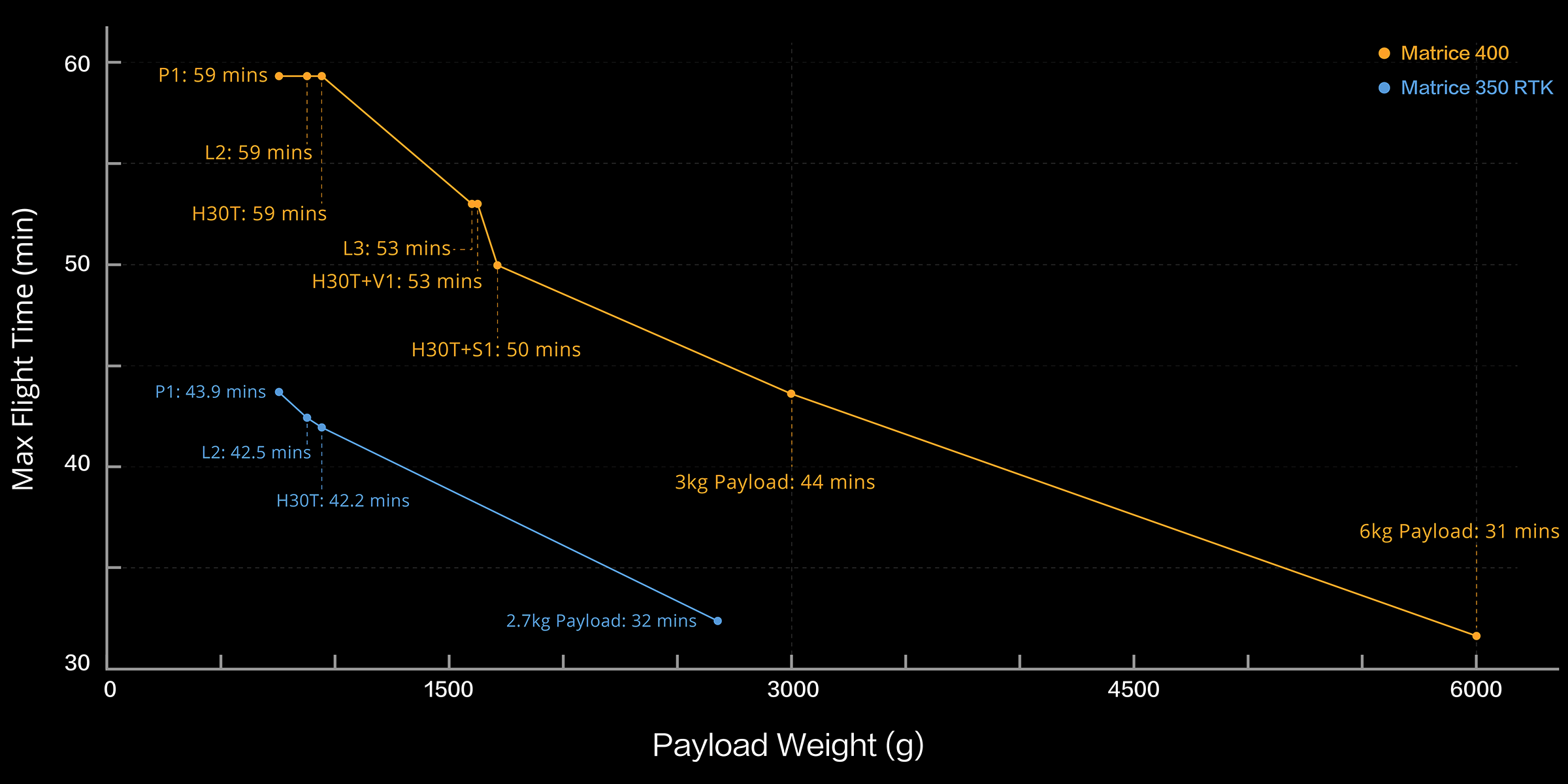
59 minutes means the H30T only, sea level, no wind, and a flight to depletion
DJI measured 59 minutes flying forward at a constant 10 m/s, windless, at sea level. The aircraft carried only the Zenmuse H30T, 10,670 g in total, and flew to battery depletion. Fit the DJI AP100 Parachute and DJI puts it at approximately 53 minutes, with the downward and backward mmWave radars automatically disabled. Range is 49 km at 17 m/s under those same conditions. Top horizontal speed is 25 m/s, sea level, no wind. Ascent is 10 m/s, descent 8 m/s, and 12 m/s is DJI's wind limit for takeoff and landing. Maximum takeoff altitude is 7000 m on the standard 2510F propellers, and DJI offers no high altitude propeller. All of it runs on one battery.
03
One battery, a 45 second swap window, and DJI is silent on air transport
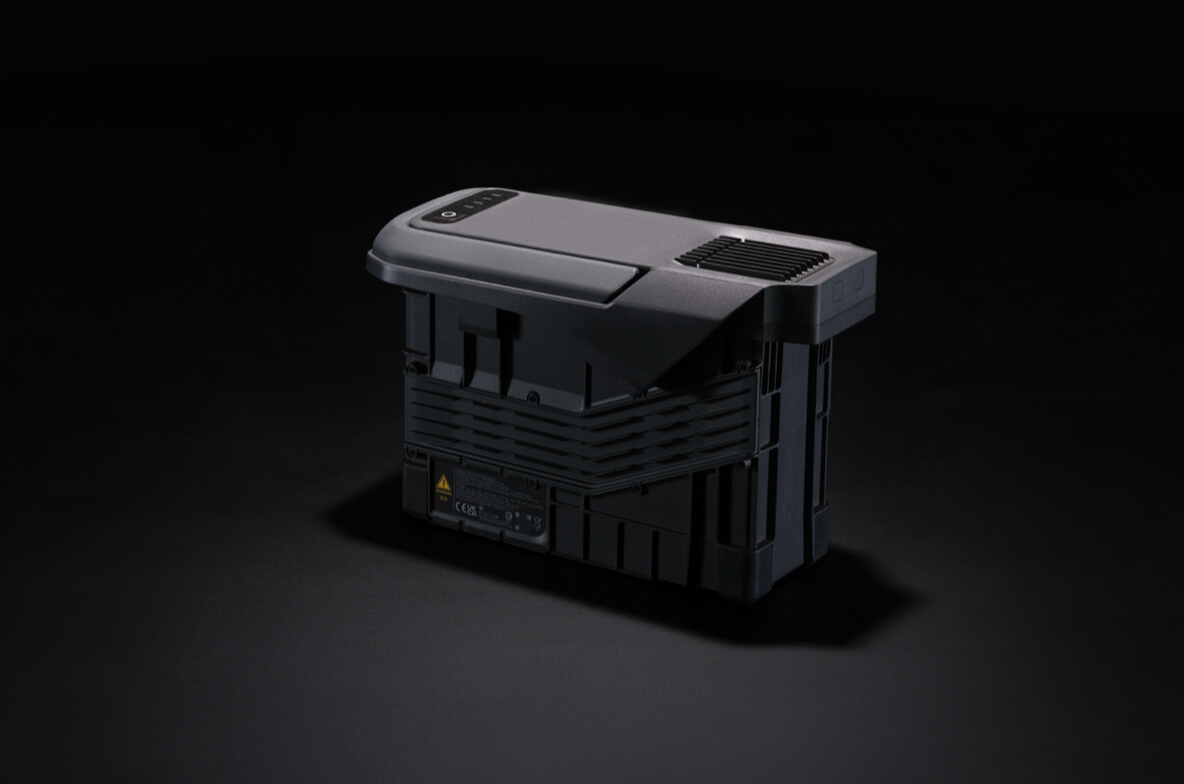
The TB100 is a Li-ion 13S pack, 20,254 mAh and 977 Wh. DJI's configuration answer is single battery. DJI states you can hot swap the pack directly. A capacitor powers the essential components during the change, and a swap completed within 45 seconds lets it resume operation quickly. It is rated for 400 cycles, and DJI does not recommend use after that. Cold is two numbers, not one. Below 5 °C it heats itself in the battery station, below 20 °C once inside the aircraft. It cannot be used below -20 °C, -4 °F. DJI recommends discharging to 30 percent or lower before transport. On air transport DJI publishes nothing: no airline or dangerous goods classification in its support material. Check with your carrier or freight provider.
04
The sensing suite is built to find wire, and DJI names where it stops working
Sensing runs on binocular vision in every direction, a rotating LiDAR, an upward LiDAR, a downward 3D infrared range sensor, and six direction mmWave radar, four with the AP100 Parachute fitted. LiDAR is laser ranging; mmWave is millimeter wave radar, the part that finds thin wire. It detects a 12 mm steel core aluminum stranded wire at 36 m, a 21.6 mm one at 50 m. DJI states the function may be unavailable or restricted in some countries or regions. Sensing holds at 25 m/s against a single main line, 17 m/s with a distribution line too. Cloud, fog, rain and snow change what it sees, and DJI states it does not actively avoid fast moving objects. With RTK enabled, a live satellite correction, it positions to 1 cm plus 1 ppm horizontally, 1.5 cm plus 1 ppm vertically, in Fix status.
05
Payload weight costs damper life on two connectors, and DJI publishes no mapping accuracy for this drone
There are four external E-Port V2 accessory ports, and the E4 port expands into four payload ports with the E-Port HUB expansion plate, for seven in total. The single gimbal connector takes 1400 g, the Zenmuse L3 connector 2100 g, the dual connector 950 g per side. The third takes 3 kg on quick release, 6 kg with screw lock fastening at sea level, decreasing with altitude. Across the single downward, dual downward and third connectors together, DJI caps non-DJI payloads at 6 kg total. Above 950 g on the single connector, and above 1600 g on the L3, the gimbal damper lifespan falls from 1000 hours to 400 hours. The damper is the vibration isolator between drone and payload, so a heavy sensor buys 40 percent of its rated life. DJI publishes no mapping accuracy figure for this aircraft.

06
IP55 is conditional, and DJI names five things that void it
IP55, ingress protection against dust and water jets, is not permanent on this aircraft. DJI achieved it under stable laboratory conditions with the official Intelligent Flight Battery fitted, and states the rating may lower over an extended period. It then names five circumstances in which the aircraft does not achieve IP55. A battery other than the official one. A battery not firmly installed. An expansion port cover left open when the port is unused. A cellular dongle compartment, speaker or spotlight not firmly installed or screwed down. A cracked shell, or water resistant adhesive that has aged or been damaged. Do not fly when rainfall exceeds 100 mm in 24 hours, and the warranty does not cover water damage. Operating temperature is -20 °C to 50 °C, or -4 °F to 122 °F, without solar radiation.
07 FOR UNIVERSITIES, COLLEGES AND GOVERNMENT AGENCIES
Who should not buy this, and how to buy it if you should
Moving up from a Matrice 350 RTK, the H30, H30T, L2 and P1 come with you; the accessories, DJI states, do not. Where DJI restricts the mmWave radar, part of the sensing suite may not switch on. A purchase order needing a survey accuracy figure for the drone will not find one from DJI. My Surveying Direct is an authorized DJI Enterprise dealer, and we accept purchase orders from universities, colleges and government agencies. The aircraft is shipped direct from the manufacturer. Call +1 888 850 6533, Monday to Friday, 9 to 5 Mountain Time, and we will confirm what fits your order before you buy.
Checkout above. Financing available with Affirm.
Institutions only: universities, colleges and government agencies.
Attached automatically.
Send the certificate once, we hold it on file.
On request, for committee approval.
One person, from quote to delivery.
Everything it does, in detail
The technical walkthrough, for the buyer who has already decided this is the platform.
REFERENCE
Specifications
Flight performance
| Max flight time | 59 minutes, measured flying forward at a constant 10 m/s in a windless environment at sea level, carrying only the H30T at a total weight of 10,670 g, until a forced landing from battery depletion. With the DJI AP100 Parachute fitted, approximately 53 minutes |
| Max hover time | 53 minutes, measured hovering in a windless environment at sea level, carrying only the H30T at a total weight of 10,670 g, from 100% battery to 0% |
| Max flight distance | 49 km, measured flying forward at a constant 17 m/s in a windless environment at sea level, carrying only the H30T at a total weight of 10,670 g, from 100% battery to 0% |
| Max horizontal speed | 25 m/s, at sea level, no wind |
| Max ascent / descent speed | 10 m/s ascent, 8 m/s descent |
| Max wind speed resistance | 12 m/s, which DJI states as the maximum during takeoff and landing |
| Max takeoff altitude | 7000 m, with the standard 2510F propellers; DJI does not offer a high-altitude propeller for this aircraft |
| Max takeoff weight | 15.8 kg |
| Takeoff weight, with propellers | 5020±20 g without batteries, 9740±40 g with batteries |
Ingress protection and environment
| Ingress protection rating | IP55 under IEC 60529, achieved under stable laboratory conditions when the official Intelligent Flight Battery is fitted. Not permanent; may lower with wear over time |
| What voids the IP55 rating | DJI states the rating does not hold if: a non-official battery is used, the battery is not firmly installed, an expansion port cover is left open, the cellular dongle compartment, speaker or spotlight is not firmly installed or screwed down, or the aircraft shell is cracked or its water-resistant adhesive has aged or is damaged |
| Rain limit | Do not fly when rainfall exceeds 100 mm in 24 hours |
| Water damage | DJI states the product warranty does not cover water damage |
| Operating temperature | -20° to 50° C (-4° to 122° F), without solar radiation |
Sensing and obstacle avoidance
| Sensing system | Omnidirectional binocular vision, horizontal rotating LiDAR, upward LiDAR, downward 3D infrared range sensor, six-direction mmWave radar |
| Rotating LiDAR range | 0.5 to 100 m at 100,000 lux against a 10% reflectivity target; 35 m at a 30° angle detecting a 21.6 mm steel-core aluminum stranded wire |
| Rotating LiDAR eye safety | Class 1 under IEC 60825-1:2014, eye-safe |
| mmWave radar, power line detection | 36 m for a 12 mm steel-core aluminum stranded wire, 50 m for a 21.6 mm steel-core aluminum stranded wire |
| mmWave radar availability | DJI's specs-page footnote states the function "may be unavailable or restricted in some countries or regions"; DJI's FAQ states it "is unavailable in some countries/regions". The two DJI statements differ in force and DJI has not reconciled them, so we publish the hedged wording, the only one both instances support |
| Sensing with the DJI AP100 Parachute fitted | DJI states the aircraft "will automatically disable its downward and backward mmWave radars once DJI AP100 Parachute is mounted", limiting its ability to sense small obstacles in those two directions. DJI also requires the gimbal safety tether to be attached to the gimbal connector when flying with the parachute |
| Obstacle sensing at speed | Up to 25 m/s facing a single main line (21.6 mm), reduced to 17 m/s when both a main line and a distribution line (12 mm) are present |
| Obstacle sensing limits | DJI states performance varies with cloud, fog, rain, or snow, and with the material, position, and shape of the target; the aircraft does not actively avoid fast-moving objects |
Positioning
| GNSS, aircraft | GPS + Galileo + BeiDou + GLONASS; GLONASS is supported only when the RTK module is enabled |
| Hovering accuracy | With moderate or no wind. Vertical: ±0.1 m with vision positioning, ±0.5 m with satellite positioning, ±0.1 m with RTK. Horizontal: ±0.3 m with vision positioning, ±0.5 m with satellite positioning, ±0.1 m with RTK |
| RTK GNSS accuracy | 1 cm + 1 ppm horizontal, 1.5 cm + 1 ppm vertical, in RTK Fix status |
| RTK heading accuracy | Better than 2° |
Video transmission and connectivity
| Video transmission system | DJI O4 Enterprise Enhanced |
| Max transmission distance | 40 km under FCC, 20 km under CE/SRRC/MIC; DJI measures this unobstructed and free of interference, for one-way non-return flight |
| Airborne relay | One Matrice 400 can relay for one additional Matrice 400; unavailable in countries or regions without 5 GHz frequency support |
| Cellular | Supports installation of two DJI Cellular Dongle 2 modules for 4G enhanced transmission |
| ADS-B In | Standard airborne ADS-B In receiver with dual antennas, reception up to 20 km |
TB100 flight battery
| Capacity and energy | 20,254 mAh, 977 Wh, Li-ion 13S |
| Configuration | Single battery; DJI's FAQ answer to "dual batteries or a single battery" is "Single battery." DJI does not offer a dual-battery configuration, which is not the same as no hot swap: DJI states "you can hot-swap the battery directly", and that a built-in capacitor provides backup power to essential components during replacement, so "if the battery swap is completed within 45 seconds, the aircraft can resume operation quickly" |
| Cycle count | Rated for 400 cycles; DJI states continued use afterward is not recommended |
| Charging temperature | 5° to 45° C (41° to 113° F); ideal range 22° to 28° C (71.6° to 82.4° F); charging stops automatically above 55° C (131° F) cell temperature |
| Discharging temperature | -20° to 75° C (-4° to 167° F); DJI states the battery cannot be used below -20° C (-4° F) |
| Self-heating | Below 5° C in the battery station, or below 20° C in the aircraft, the battery heats itself automatically before charging or flight; these are two different thresholds for two different contexts, not one figure |
| Storage guidance | DJI's general guidance for the battery and remote controller together: 22° to 28° C (71° to 82° F) for storage over three months, never outside -10° to 45° C (14° to 113° F); DJI does not publish a storage-temperature figure for the TB100 alone |
| Before transporting | DJI recommends discharging the battery to 30% or lower before transportation, for safety |
| Fast charging time | 45 minutes on 220 V, 70 minutes on 110 V, both in Fast Charging Mode, measured at 25° C (77° F) |
Gimbal and payload mounting
| Max simultaneous payloads | Up to 7, counted from the E-Port V2 ports alone: 4 external E-Port V2 ports, of which the E4 port can be expanded into 4 payload ports via the E-Port HUB expansion plate. DJI's count does not include the gimbal connectors |
| Total non-DJI payload weight | DJI states that when the single downward gimbal, the dual downward gimbal and the third gimbal connector are used simultaneously, the total weight of non-DJI payloads must not exceed 6 kg |
| Single gimbal connector | 1400 g max payload. DJI states that above 950 g the gimbal damper lifespan falls from 1000 hours to 400 hours |
| Zenmuse L3 gimbal connector | 2100 g max payload. DJI states that above 1600 g the gimbal damper lifespan falls from 1000 hours to 400 hours |
| Dual gimbal connector | 950 g max payload, per connector |
| Third gimbal connector | 3 kg on the quick-release port, 6 kg with screw-lock fastening; DJI states the 6 kg figure is measured at sea level and decreases with altitude |
| Upward gimbal connector | Not supported; DJI confirms no upward gimbal connector option exists on this aircraft |
Ordering
| Dealer status | Authorized DJI Enterprise dealer |
| Purchase orders | Accepted from universities, colleges and government agencies |
| Shipping | Shipped direct from the manufacturer |
| Speak to us | +1 888 850 6533, Monday to Friday, 9 to 5 Mountain Time |