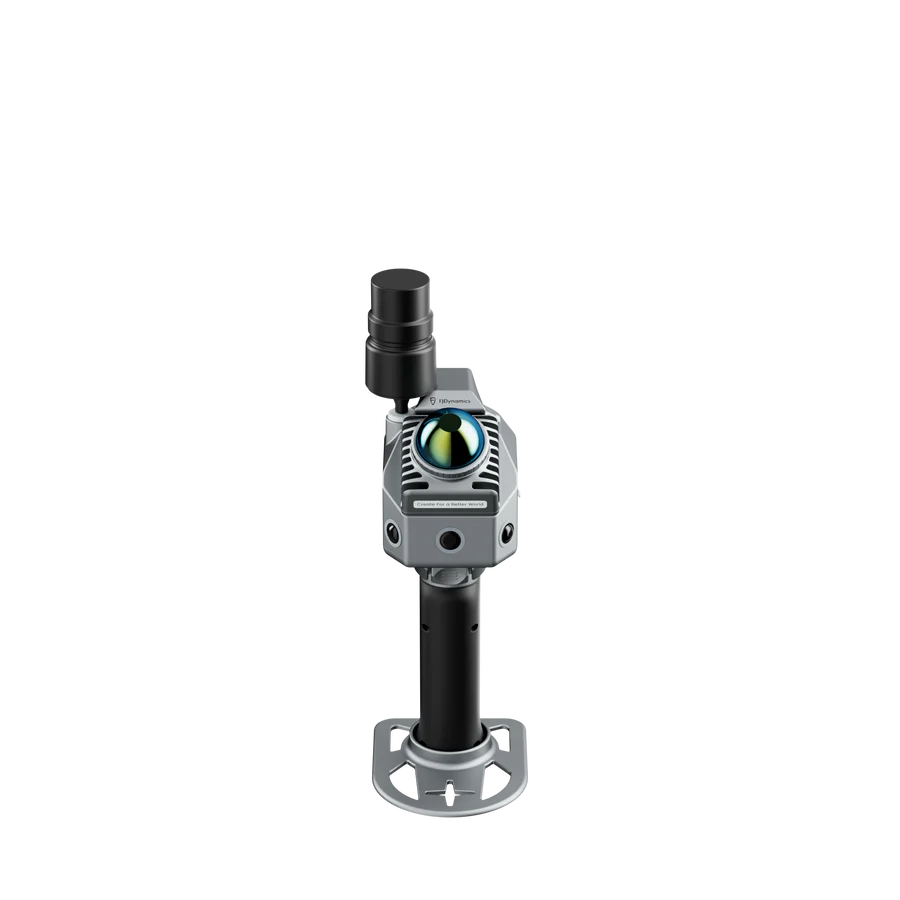
FJ Dynamics Trion P2 Handheld LiDAR Scanner
W-9 and vendor pack with every quote
Shipped direct from the manufacturer
A handheld LiDAR scanner that maps as you walk, rated 70 m at best reflectivity. Both FJ Dynamics configurations include GNSS/RTK, and full color panoramas need a separate Insta360 camera.
01
FJ Dynamics publishes two purchase configurations for the P2, and both include the GNSS/RTK module
The hardware manual names Option A, the scanner paired with an external panoramic camera, and Option B, the GNSS/RTK module alone. GNSS is satellite positioning, and RTK, real-time kinematic, is a live correction signal that sharpens it toward survey grade. Both configurations include that module, so the range, accuracy and weight figures below assume it's fitted. Call +1 888 850 6533 to confirm what your order includes. Want panoramic capture in full color too? FJ Dynamics names the Insta360 X3 or X5 as the supported camera, sold separately.
Go-anywhere scanning
FJD Trion's own product film for the P2, linked from the "Watch Video" button on the manufacturer's product page.
02
The P2 is a handheld scanner: walk through a space and it builds a 3D point cloud in real time
LiDAR, light detection and ranging, fires a laser and times its return to plot distance. The P2 spins that laser 360 degrees horizontally and 59 degrees vertically, at 200,000 points a second. That builds a point cloud, a 3D map of individually measured points, live on a connected mobile terminal. A front camera and two side cameras add color. They also enable visual SLAM, simultaneous localization and mapping, the technique that tracks the scanner's position from those images as you walk. That's how it holds its place without external tracking hardware. Range and accuracy are where the published numbers need close reading.
03
Scanning range is rated at 70 meters, but only against a bright target; darker surfaces roughly halve it
FJ Dynamics rates the P2 at 70 m against an 80% reflectivity target, how much light a surface bounces back. Against a darker, 10% reflectivity target, closer to dark stone or dense foliage, range drops to 40 m. Accuracy calculated after the scan, in desktop software, is lab tested at 1 cm relative, 3 cm absolute, per the brochure. Accuracy in real time while scanning is looser: 2 cm relative, 5 cm absolute. The live product page's own headline shows a different figure, 1.2 cm, and the manual states a flat 12 mm with no test condition. We use the brochure's lab tested 1 cm figure; it agrees with its own detailed spec row. The rest are recorded, not resolved, worth raising with FJ Dynamics first. RTK runs 8 mm + 1 ppm horizontal, 15 mm + 1 ppm vertical.
04
Battery life is rated at 4 hours by FJ Dynamics' own marketing, but its own manual says under 2
The product page and brochure agree: 4 hours from a set of two batteries with the GNSS/RTK module fitted, dropping to 3 hours with an external camera attached. The hardware manual instead states 1 hour 50 minutes without the camera and 1 hour 30 minutes with it, roughly half the marketed figure. We can't reconcile that from FJ Dynamics' own materials; ask them, or call us, first. Charging is easier to agree on. A 67 W charger tops up one battery in about 1.5 hours over USB-C on the handle; both can charge at once. Use only the original charger. Third party chargers are strictly prohibited.
05
Weight ranges from 700 grams bare to 1,500 grams fully equipped, and the manual gives a third number again
FJ Dynamics lists the P2 core unit at 700 g, excluding battery, external camera and GNSS/RTK module. With the battery and module fitted, it's 1,200 g. Add an Insta360 camera and it reaches 1,500 g. The hardware manual instead states a single flat 1 kg figure that doesn't map onto the breakdown above. We use the product page and brochure figures here; they agree with each other. Operating range is -20°C to 50°C, storage -40°C to 60°C. The IP54 dust and splash rating cites no test standard on any manufacturer surface checked.
06
The side cameras built into the P2 are 48 megapixels on the product page and 12 on the manual; we're not picking a side
Two side cameras plus a front camera give the point cloud its color and support visual SLAM. FJ Dynamics' product page and brochure both call the side sensors dual 48 MP flagship sensors. The hardware manual's own spec table instead lists 12 megapixels per fisheye lens. Two independent dealers also state 12 MP: three sources against two. For panoramic capture in full color, the P2 pairs with an external Insta360 X3 or X5. The X3 shoots up to 5.7K video and 72 MP stills; the X5 goes to 8K. Both sold separately; call +1 888 850 6533 to confirm what ships with yours.
07 FOR UNIVERSITIES, COLLEGES AND GOVERNMENT AGENCIES
My Surveying Direct accepts purchase orders from universities, colleges and government agencies for either configuration
Whichever configuration fits your work, Option A with the camera or Option B without, we accept purchase orders from universities, colleges and government agencies. Every P2 ships direct from FJ Dynamics. FJ Dynamics doesn't publish a written packing list for the P2, only an unboxing video. So before you order, call +1 888 850 6533, Monday to Friday, 9 to 5 Mountain Time. We'll confirm what's in your box and which configuration matches your workflow.
Checkout above. Financing available with Affirm.
Institutions only: universities, colleges and government agencies.
Attached automatically.
Send the certificate once, we hold it on file.
On request, for committee approval.
One person, from quote to delivery.
What's actually in the box
FJD Trion's own unboxing and quick-start video for the P2, embedded on their support center page. The closest thing to a published packing list, since no text list exists.
REFERENCE
Specifications
LiDAR
| Point rate | 200,000 pts/s |
| Field of view | 360° x 59° |
| Scanning range | 40 m at 10% reflectivity, 70 m at 80% reflectivity |
| Laser wavelength | 905 nm |
| Laser safety class | Class 1, eye-safe. The hardware manual states this device satisfies IEC 60825-1:2014 and 21 CFR 1040.10/1040.11, except for deviations under Laser Notice No. 56, dated 8 May 2019 |
| Point cloud processing | Real-time |
| Point cloud display | Real-time preview on a mobile terminal |
| Continue scanning | Supported |
| HyperDense+ | Supported. Delivers 5-7x denser point clouds at a spacing of up to 1 mm via FJD Trion Model processing |
Accuracy and positioning
| Post-processed point cloud accuracy | Relative 1 cm, absolute 3 cm (lab-tested; actual results may vary, per the brochure's own footnote) |
| Real-time point cloud accuracy | Relative 2 cm, absolute 5 cm |
| Hardware manual accuracy figure | The manual states a single flat accuracy figure of 12 mm (equivalent to 1.2 cm), with no real-time/post-processed breakdown and no stated test condition |
| RTK horizontal accuracy | 8 mm + 1 ppm RMS |
| RTK vertical accuracy | 15 mm + 1 ppm RMS |
| Positioning rate | 10 Hz |
| PPK | Supported |
Built-in camera
| Front camera field of view | 70° |
| Side camera field of view | 280° x 149° |
| Front camera resolution | 2 MP, global shutter (motion capture without blur, per the product page) |
| Side camera resolution (product page and brochure) | 2 x 48 MP. The brochure describes these as "dual 48MP flagship sensors" |
| Side camera resolution (hardware manual) | FJD's own hardware manual instead lists "Fisheye Camera pixels: 12M x 2" for what appears to be the same built-in side cameras, and two independent dealers also state 2 x 12 MP rather than 48 MP |
| Visual SLAM | Supported |
| Image export | Supported, .jpg format |
External camera (Insta360)
| Supported models | Insta360 X3, Insta360 X5 |
| Insta360 X3 360° video resolution | Up to 5.7K, 5760 x 2880 @ 30/25/24 fps |
| Insta360 X5 360° video resolution | Up to 8K, 7680 x 3840 @ 30/25/24 fps |
| Insta360 X3 photo resolution | 72 MP (11968 x 5984) or 18 MP (5952 x 2976) |
| Insta360 X5 photo resolution | Approx. 72 MP (11904 x 5952) or approx. 18 MP (5888 x 2944) |
| Video format | 360°: INSV; single-lens: MP4 |
System parameters
| Dimensions (product page and brochure) | 110 x 106 x 280 mm |
| Dimensions (hardware manual) | FJD's own hardware manual instead states 87 x 90 x 270 mm, excluding the camera module |
| Weight | 700 g excluding battery, external camera and GNSS/RTK module; 1200 g including battery and module; 1500 g including battery, module and external camera |
| Weight (hardware manual) | FJD's own hardware manual instead states a single figure of 1 kg, excluding the camera module and base plate, which does not map cleanly onto the three-tier breakdown above |
| Storage | 512 GB SSD, 1 TB expandable |
| Operating temperature | -20°C to 50°C |
| Storage temperature | -40°C to 60°C |
| Ingress protection | IP54. No test standard (e.g. IEC 60529) is cited on any of the four manufacturer surfaces checked |
| Data export | Wireless network, USB Type-C, USB flash disk |
| Point cloud formats | .las / .ply / .pts / .e57 |
Electrical specifications
| Battery life | 4H with 1 set of 2 batteries including the GNSS/RTK module, excluding external camera; 3H with 1 set of 2 batteries including the GNSS/RTK module and external camera |
| Battery life (hardware manual) | FJD's own hardware manual instead states 1 h 50 min excluding the camera module and 1 h 30 min including it, roughly half the product page's figure |
| Power supply | DC handheld battery |
| Power consumption | 15 W excluding external camera; 21 W including external camera |
| Power consumption (hardware manual) | FJD's own hardware manual instead states a single flat figure of 14 W |
| Supply voltage and current | 10.8 V, 3 A |
| Charger | 67W fast charging. The manual states: "Use only the original charger during charging. Third-party chargers are strictly prohibited" |
| Independent charging time | About 1.5 hours to fully charge via the Type-C port on the handle |
| Simultaneous dual-battery charging | Supported |
GNSS
| Satellite constellations | BDS (B1I/B2I/B3I/B1C/B2a/B2b), GPS (L1 C/A/L1C/L2P(Y)/L2C/L5), GLONASS (G1/G2/G3), Galileo (E1/E5a/E5b/E6), QZSS (L1C/A/L1C/L2C/L5). IRNSS and SBAS supported via a firmware upgrade |
| Wi-Fi | 2.4 GHz |
Safety and cautions (from the hardware manual)
| Laser certification | Satisfies IEC 60825-1:2014 and 21 CFR 1040.10/1040.11, except deviations per Laser Notice No. 56, dated 8 May 2019 |
| Magnifying devices | Although Class 1 compliant, do not use a microscope, magnifying glass or other magnifying device to look directly at the laser |
| Direct viewing | To ensure maximum self-protection, do not look directly at the running LiDAR |
| Rotating head | Do not block or interrupt the LiDAR while it is rotating |
| Cable handling | Do not plug and unplug the connecting cables repeatedly; do not forcibly bend or pull the connecting cables; do not insert unrelated objects into the connectors |
| Ambient temperature | Use at normal ambient temperatures and avoid extreme temperatures, otherwise battery life will be shortened or unpredictable risks may occur |
| Battery water and heat exposure | Do not immerse the batteries in water; store in a cool, dry place when not in use; do not use or place batteries near heat sources such as fire and heaters |
| Charger requirement | Use only the original charger during charging; third-party chargers are strictly prohibited |
| Battery terminals | Do not reverse the battery's positive and negative terminals; never insert the battery directly into a power outlet; prohibit metal objects from touching both battery terminals |
| Unused battery storage | Recharge the battery every 3 months if unused, to prevent deep discharge |
| Battery disassembly | Do not disassemble the battery casing, weld it, or puncture it with sharp objects |
| Charge/discharge temperature limits | Charging temperature: 0-45°C. Discharge temperature: -20-50°C (50°C applicable only when the battery is integrated with the device) |
| Type-C port during use | Avoid unplugging or reconnecting the battery's Type-C port while the device is in use |
Software ecosystem
| FJD Trion Scan | Data collection app: real-time app control and scan file management |
| FJD Trion Model | Data processing: generates reports for construction, forestry, mining and more |
| FJD Trion Model for Tablets | On-site post-processing and preview, with iPad and Android support |
| FJD Trion Model Web | Cloud collaboration: share data online and collaborate across teams. Both listed dealer pages instead name this tool "FJD Trion Explorer" for what appears to be the same function, while FJD's own product page and brochure both use "FJD Trion Model Web" |
| Software version requirements | Per the P2's own firmware release notes, mapping and point cloud colorization require FJD Trion Model PC V207.001 or above, Model iPad V1.10 or above, or Model Android Pad V1.3 or above; infrared camera data processing requires Model PC V207.001 or above (not supported on Pad) |
Ordering
| Dealer status | My Surveying Direct, vendor: FJ Dynamics |
| Purchase orders | Accepted from universities, colleges and government agencies |
| Shipping | Shipped direct from the manufacturer |
| Speak to us | +1 888 850 6533, Monday to Friday, 9 to 5 Mountain Time |