
DJI Matrice 4T Drone
W-9 and vendor pack with every quote
Shipped direct from the manufacturer
A 640 × 512 thermal camera, a laser rangefinder, 49 minutes in windless air. DJI says the RTK module cannot guarantee the final mapping precision, and rates ingress protection as No Standard Protection Level.
01
If you owe a client a measured map, order the Matrice 4E and not this one
The Matrice 4 series is two aircraft, and this is the thermal one. DJI's FAQ draws the line itself. "DJI Matrice 4E supports precise mapping after enabling RTK function", it says, while "Equipping DJI Matrice 4T with the RTK module can't guarantee the final precision." RTK is a live satellite correction on top of GPS. DJI adds that the tele camera cannot map without ground control points, surveyed markers placed on the site, and that only the 4E's wide camera can. So the 4E is the purchase for geospatial work. We sell both, and this page is about heat.
Two aircraft, one drone family
DJI Enterprise's launch film for the Matrice 4 series.
02
The 4T does fly mapping routes, and a DJI field says which photos are fit for mapping
Smart oblique capture, shooting at an angle instead of straight down, is supported in the area route's oblique collection function. DJI describes five directions in an X pattern, where the Zenmuse P1's five run in a + pattern. DJI publishes no mapping accuracy figure for this aircraft, so we state none. Its manual documents a SurveyingMode field in the photo metadata: 0 means that photo's accuracy cannot be guaranteed, 1 means it can. Not the aircraft for you if a stated accuracy is the deliverable, or if you need DNG RAW, because the 4T shoots JPEG only.
03
640 × 512 is the detector, and 1280 × 1024 is Super Resolution on top of it
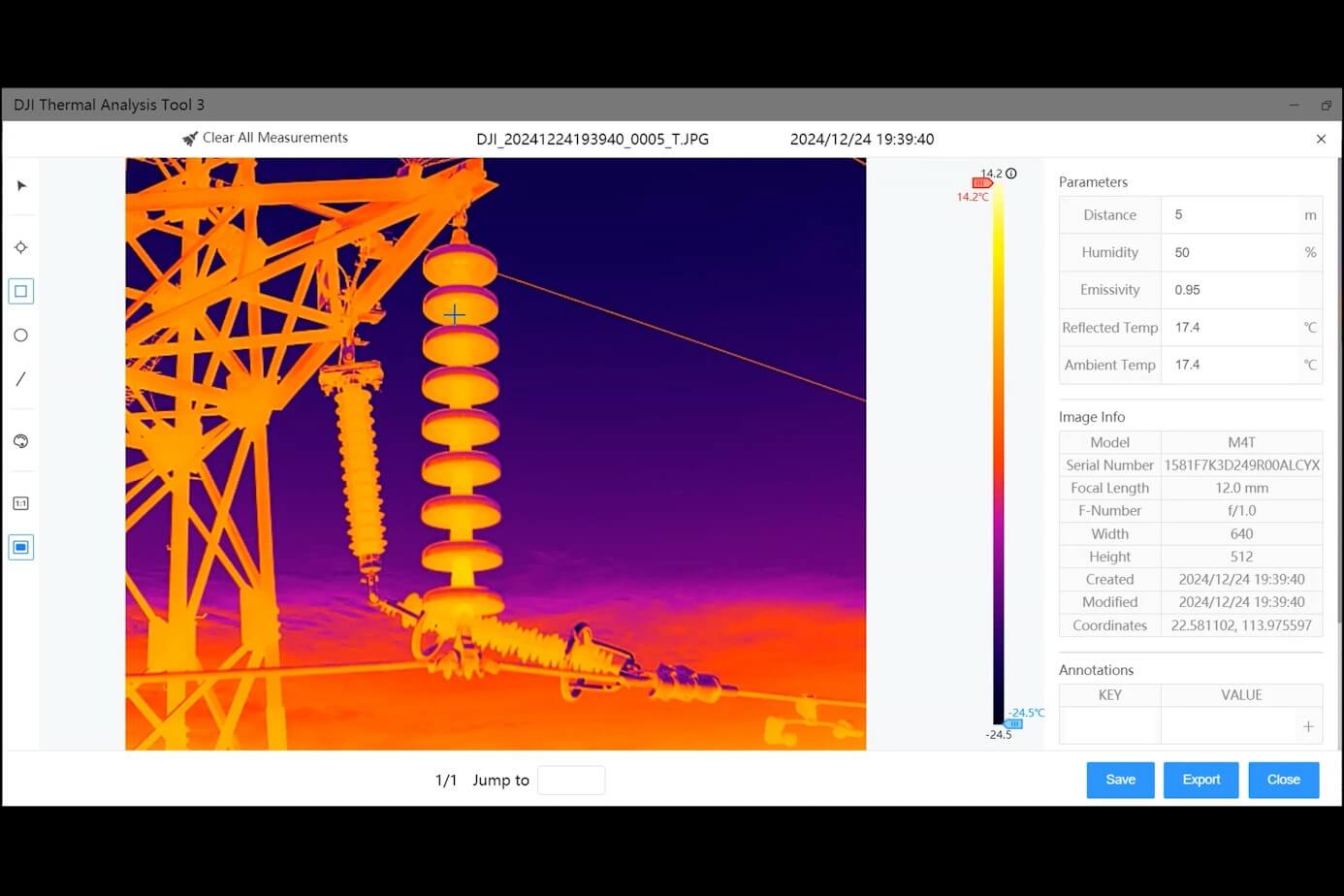
The thermal sensor is uncooled vanadium oxide at 640 × 512, running at 30 Hz. DJI also publishes 1280 × 1024 with Super Resolution enabled and Night Mode off. The detector resolves 640 × 512, and the larger figure is what Super Resolution builds from it. The lens is f/1.0 at 53 mm equivalent, 45 degrees across the diagonal, focused from 5 m to infinity. Gain sets the measurement window. High Gain covers -20 °C to 150 °C to ±2 °C or ±2%, whichever is greater. Low Gain covers 0 °C to 550 °C to ±5 °C or ±3%, whichever is greater. Digital zoom reaches 28x. Then DJI's caution: "DO NOT expose the infrared camera lenses to strong sources of energy such as the sun, lava, or a laser beam. Otherwise, the camera sensor may be burned leading to permanent damage."
04
Three cameras for visible light, one laser, and two parts you never look into
The three visible cameras are 48 MP effective and fixed. A wide at 24 mm equivalent and f/1.7, a medium tele at 70 mm, a tele at 168 mm. Only the tele zooms, 16x digital, which DJI also states as 112x hybrid through that lens. The laser rangefinder reads to 1800 m at 20% target reflectivity, with a 1 m blind zone. Error beyond 3 m is ±(0.2 + 0.0015 × D) m. The 4E carries the same rangefinder. DJI's instruction: do not look directly at it, or at the NIR auxiliary light, while the aircraft is powered on. DJI's specification gives that light a field of view, 5.7 degrees, and no illumination distance. A reach figure appears in DJI's product copy and not in the specification, so we state none. Ask us before you plan night work around a range.

05
The 49 minutes is windless, unloaded and flown to a flat battery
DJI measured it at about 9 m/s, no payload, no wind, run down to 0%. Plan for less. Wind resistance is 12 m/s and DJI attaches that to takeoff and landing only. Aircraft and battery both work from -10 °C to 40 °C, and the battery has no self heating and no low temperature charging. Charging runs through the Charging Hub; DJI answers directly that the aircraft itself cannot be charged. RTK positioning holds 1 cm + 1 ppm horizontal and 1.5 cm + 1 ppm vertical in Fix status. That is where the aircraft knows it is, not the accuracy of a map built from it. The ppm term grows with distance from the correction source.
06
DJI's rating is No Standard Protection Level, and its instruction for rain is to land
There is no IP rating on this aircraft. IP is the ingress protection scale, the two digit dust and water rating. DJI's own entry is "No Standard Protection Level", and that is the whole of it. The FAQ is plainer: "Is DJI Matrice 4 Series waterproof? No... If it rains during the flight, return and land as soon as possible, and wait until the aircraft is fully dry inside and out before using it again." DJI's safety guidelines add another: do not power on with water inside the aircraft or its components, which may cause permanent component damage. The manual says not to use the aircraft in dusty or humid environments.
07 FOR UNIVERSITIES, COLLEGES AND GOVERNMENT AGENCIES
Three things to confirm with us before you order it
DJI answers "Can I use the DJI Matrice 4 Series across countries or regions? No. Please confirm the applicable countries and regions with your dealer before purchasing", so tell us where it will fly. DJI's Dock 3 is equipped with the Matrice 4D or 4TD, not this aircraft, so if your operation runs from a dock, say so. And we will not print a packing list we cannot match to your exact order, so we confirm that on the phone. The RC Plus 2 Enterprise Edition controller ships as standard, and the Enhanced Edition is bought separately. My Surveying Direct is an authorized DJI Enterprise dealer, ships direct from the manufacturer, and takes purchase orders from universities, colleges and government agencies. Call +1 888 850 6533, Monday to Friday, 9 to 5 Mountain Time.
Checkout above. Financing available with Affirm.
Institutions only: universities, colleges and government agencies.
Attached automatically.
Send the certificate once, we hold it on file.
On request, for committee approval.
One person, from quote to delivery.
Everything it does, in detail
DJI Enterprise's technical walkthrough of the Matrice 4T and Matrice 4E.
REFERENCE
Specifications
Aircraft
| Takeoff weight | 1219 g with standard propellers, 1229 g with low-noise propellers, including the battery, propellers and a microSD card |
| Max takeoff weight | 1420 g with standard propellers, 1430 g with low-noise propellers |
| Dimensions | Folded 260.6 × 113.7 × 138.4 mm, unfolded 307.0 × 387.5 × 149.5 mm (L×W×H), excluding propellers |
| Max payload | 200 g |
| Max flight time | 49 min with standard propellers, 46 min with low-noise propellers; measured flying at approximately 9 m/s with no payload in windless conditions until 0% battery |
| Max flight distance | 35 km with standard propellers, 32 km with low-noise propellers, measured at approximately 14 m/s in windless conditions |
| Max horizontal speed | 21 m/s forward, 18 m/s backward, 19 m/s sideways, at sea level with no wind |
| Max wind resistance | 12 m/s, during takeoff and landing only |
| Max altitude | 6000 m; 4000 m maximum operating altitude with a payload attached |
| Operating temperature | -10 °C to 40 °C (14 °F to 104 °F) |
| GNSS | GPS + Galileo + BeiDou + GLONASS; GLONASS is supported only when the RTK module is enabled |
| Hovering accuracy | ±0.1 m with the vision system, ±0.5 m with GNSS only, ±0.1 m with RTK, in windless or breezy conditions |
| RTK positioning accuracy | RTK Fix status: 1 cm + 1 ppm horizontal, 1.5 cm + 1 ppm vertical |
| RTK module | Built into the aircraft. Asked whether the RTK module is removable, DJI answers "No." |
Cameras
| Wide camera | 1/1.3-inch CMOS, 48 MP effective, f/1.7, 24 mm equivalent focal length, 82° FOV, focus 1 m to infinity |
| Medium tele camera | 1/1.3-inch CMOS, 48 MP effective, f/2.8, 70 mm equivalent focal length, 35° FOV, focus 3 m to infinity |
| Tele camera | 1/1.5-inch CMOS, 48 MP effective, f/2.8, 168 mm equivalent focal length, 15° FOV, focus 3 m to infinity, 16x digital zoom (112x hybrid zoom using the tele lens) |
| ISO range | 100 to 25600 in Normal mode; Night Scene mode extends the wide and medium tele cameras to 409600 and the tele camera to 819200 on the Matrice 4T |
| Max photo size | Wide and medium tele 8064 × 6048; tele 8192 × 6144 |
| Video | H.264/H.265, 4K at 3840 × 2160 30fps, FHD at 1920 × 1080 30fps; max bitrate 60 Mbps (H.264) or 40 Mbps (H.265) |
| Photo format | JPEG only on the Matrice 4T. The Matrice 4E's wide camera additionally shoots JPEG and DNG RAW; its medium tele and tele cameras are JPEG only, same as the 4T |
| Minimum photo interval | 0.7 s on the Matrice 4T; 0.5 s on the Matrice 4E |
Thermal camera, Matrice 4T only
| Thermal sensor | Uncooled vanadium oxide (VOx), 640 × 512 native, 1280 × 1024 with Super Resolution enabled and Night Mode off, 12 μm pixel pitch, 30 Hz frame rate |
| Thermal lens | 45° ± 0.3° DFOV, 53 mm equivalent focal length, f/1.0, focus 5 m to infinity |
| Temperature measurement range | High Gain: -20 °C to 150 °C (-4 °F to 302 °F). Low Gain: 0 °C to 550 °C (32 °F to 1022 °F) |
| Temperature measurement accuracy | High Gain: ±2 °C or ±2%, whichever is greater. Low Gain: ±5 °C or ±3%, whichever is greater |
| Digital zoom | 28× |
| Sensor protection | DJI: "DO NOT expose the infrared camera lenses to strong sources of energy such as the sun, lava, or a laser beam. Otherwise, the camera sensor may be burned leading to permanent damage." |
| Palette options | White Hot, Black Hot, Tint, Iron Red, Hot Iron, Arctic, Medical, Fulgurite, Rainbow 1, Rainbow 2 |
Laser rangefinder and NIR light
| Laser rangefinder range | 1800 m at 1 Hz, measured at 20% target reflectivity; oblique incidence range 600 m at 1 Hz; blind zone 1 m. Shared with the Matrice 4E, not a 4T-exclusive part |
| Laser rangefinder accuracy | 1 to 3 m: system error under 0.3 m, random error under 0.1 m at 1σ. Beyond 3 m: ±(0.2 + 0.0015 × D) m, where D is the measured distance in meters |
| Laser and NIR eye safety | DJI: "DO NOT look directly at the laser range finder or the NIR auxiliary light when the aircraft is powered on." |
| NIR auxiliary light | 5.7° ± 0.3° field of view (Matrice 4T only, specs page). DJI's separate product page states an illumination distance of about 100 m, a figure not repeated or corroborated on the specs page itself |
Ingress protection and environment
| Ingress protection rating | No Standard Protection Level, DJI's own term, listed under the gimbal specification and shared across the Matrice 4T and Matrice 4E |
| Waterproofing | DJI FAQ: "Is DJI Matrice 4 Series waterproof? No. Avoid contact with water during use as it may lead to damage of the device. If it rains during the flight, return and land as soon as possible, and wait until the aircraft is fully dry inside and out before using it again." |
| Powering on with water present | DJI's disclaimer and safety guidelines: "DO NOT power on the aircraft when water is inside the aircraft or its components. Otherwise, it may cause permanent component damage." |
| Dust and humidity | DJI user manual: "DO NOT use the aircraft in dusty or humid environments." Stated twice in the manual, worded identically both times |
| Gimbal protector | Ships fitted to the gimbal for transit. DJI: "Make sure to remove the gimbal protector before powering on the aircraft." |
Battery and charging
| Battery model | DJI Matrice 4 Series Intelligent Flight Battery, 6741 mAh, 14.76 V standard voltage, 99.5 Wh, 401 g, Li-ion 4S, shared between the Matrice 4T and Matrice 4E |
| Battery operating temperature | -10 °C to 40 °C (14 °F to 104 °F). DJI: battery life is shortened at low temperature |
| Battery charging temperature | 5 °C to 40 °C (41 °F to 104 °F); DJI's ideal range for prolonging battery life is 22 °C to 28 °C (72 °F to 82 °F) |
| Low-temperature charging and self-heating | Not supported on the Matrice 4 Series battery |
| Charging method | Only through the DJI Matrice 4 Series Charging Hub. DJI: "Does the DJI Matrice 4 Series support aircraft charging? No." |
| Charging time | Approximately 78 minutes to full in Standard Mode, or 60 minutes to 90% in Ready-to-Fly Mode, using the 100 W Charging Hub and 100 W Portable Charger |
| Cycle count | Rated for 200 cycles. DJI's safety guidelines note battery stability is affected beyond the rated cycle count and the battery should be replaced |
| Transport | DJI user manual: "For safety purposes, keep the batteries at a low power level in transit... it is recommended to discharge the batteries to 30% or lower." |
| Warranty condition | DJI user manual: a battery left unused for three months or more, without being charged or discharged, is no longer covered by the warranty |
Controller
| Standard controller | DJI RC Plus 2 Enterprise Edition ships as standard with the Matrice 4T |
| Enhanced Edition | DJI RC Plus 2 Enterprise Enhanced Edition is a separate purchase, adding expansion interface components for more industry payloads |
| Not compatible | DJI: the RC Plus 2 does not support the DJI Mavic 3 Enterprise Series drones, and the Matrice 4 Series is not compatible with DJI Goggles. It is also a different generation from the original DJI RC Plus, which DJI markets for the Matrice 30 Series |
| Screen and storage | 7.02-inch touchscreen, 1920 × 1200, 1400 nits, ROM 128 GB plus microSD expansion |
| Operating temperature | -20 °C to 50 °C (-4 °F to 122 °F) |
| Built-in battery | 6500 mAh at 7.2 V, 46.8 Wh; optional external WB37 battery, 4920 mAh at 7.6 V, 37 Wh |
Mapping and precision
| Precision mapping, Matrice 4T | DJI FAQ: "Equipping DJI Matrice 4T with the RTK module can't guarantee the final precision." DJI does not publish a mapping accuracy figure for the Matrice 4T |
| Precision mapping, Matrice 4E | DJI FAQ: "DJI Matrice 4E supports precise mapping after enabling RTK function." This capability is stated for the 4E only |
| Mapping without ground control points | DJI FAQ: the Matrice 4T's tele camera does not support mapping without GCPs. Only the Matrice 4E's wide camera does |
| Smart oblique capture | Supported on the Matrice 4T, in the oblique collection function of the area route. DJI: both the Matrice 4 series and the Zenmuse P1 feature 5-direction smart oblique capture; the Matrice 4 series pattern is an "X" shape, the Zenmuse P1's a "+" shape |
| Per-photo accuracy flag | DJI's user manual documents a SurveyingMode field in the photo metadata: 0 means that photo's accuracy cannot be guaranteed, 1 means it can |
Matrice 4T vs Matrice 4E
| Wide camera | Matrice 4T: 1/1.3-inch CMOS, 48 MP, f/1.7. Matrice 4E: 4/3-inch CMOS, 20 MP, f/2.8 to f/11 with a mechanical shutter option |
| Thermal and NIR | Matrice 4T only. The Matrice 4E has no thermal camera and no NIR auxiliary light |
| Photo format | Matrice 4T: JPEG only. Matrice 4E wide camera: JPEG and DNG RAW |
| Mission framing | DJI: the Matrice 4T "is suitable for a wide range of industries, including electricity, emergency response, public safety, and forestry conservation." The Matrice 4E "is designed for geospatial applications such as surveying and mapping, construction, and mining." |
Software and region
| Flight app | DJI Pilot 2, or other software built on DJI's Mobile SDK |
| Fleet management | DJI FlightHub 2 supported, including live flight control of aircraft and payload |
| Developer SDKs | Payload SDK, Mobile SDK and Cloud API supported. DJI directs developer queries to dev@dji.com |
| Cross-border use | DJI FAQ: "Can I use the DJI Matrice 4 Series across countries or regions? No. Please confirm the applicable countries and regions with your dealer before purchasing." |
| Certification | C2 certified by the European Union Aviation Safety Agency (EASA). DJI publishes no FCC certification statement for the series; its specs page cites FCC transmit power and range limits only |
Ordering
| Dealer status | Authorized DJI Enterprise dealer |
| Purchase orders | Accepted from universities, colleges and government agencies |
| Shipping | Shipped direct from the manufacturer |
| Speak to us | +1 888 850 6533, Monday to Friday, 9 to 5 Mountain Time |